
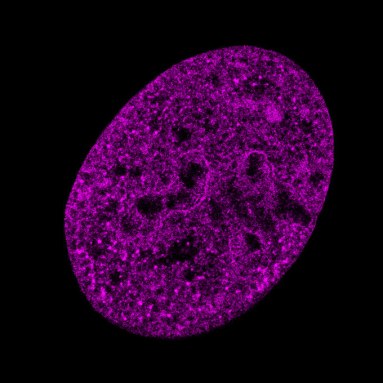
The herpesvirus can manipulate our DNA with far more precision than previously thought.
The virus condenses and changes the shape of our genetic material to hijack the host genes needed for replication, researchers report June 19 in Nature Communications. The study is the first to leverage new, cutting-edge visualization tools to understand how this process occurs, offering a clear view of cellular changes within hours of infection.
Herpes simplex virus (HSV-1), the microbial culprit behind oral herpes, infects up to 67 percent of adults under 50 worldwide, although most cases are asymptomatic. Like all viruses, HSV-1 requires a host to replicate, transforming each cell it enters into a virus-producing