
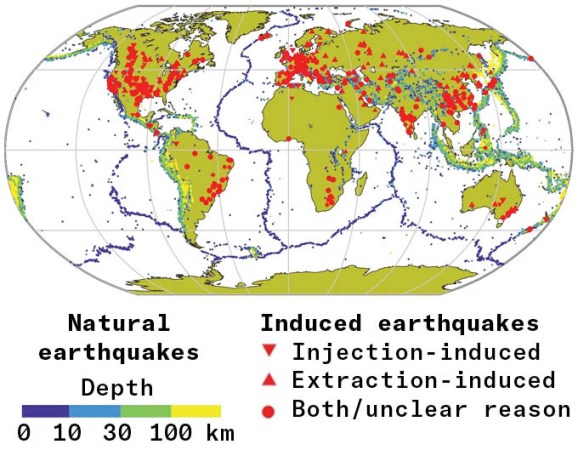
Human-caused earthquakes are real. Here’s why even stable regions can snap

On August 16, 2012, residents of the tiny Dutch village of Huizinge were rattled by an inexplicably large 3.6 magnitude earthquake. Gas extraction in the nearby Groningen gas field, one of the largest onshore gas fields in the world, was the trigger. The area typically does not experience natural earthquakes, and this was the worst induced quake to hit the Netherlands to date.

Places like Groningen, India’s Deccan Plateau and Oklahoma are tectonically stable. They don’t sit at the quake-prone boundaries of tectonic plates. What fault lines they do have lie only a few kilometers below the surface, too shallow to trigger significant natural shakes. Even if the rocks

→ Continue reading at Science News

More from author

Related posts

Advertisment

Latest posts

Ancient DNA reveals China’s first ‘pet’ cat wasn’t the house cat

The house cat (Felis catus) slunk into China in the eighth century. But long before that, the ancient Chinese were by no means catless....

Thursday’s Cold Moon Is the Last Supermoon of the Year. Here’s How and When to View It

A cold supermoon is on its way. On December 4, Earth's satellite will delight us with one of the last astronomical spectacles of 2025....

Ancient southern Africans took genetic evolution in a new direction

Important, previously unrecognized genetic changes common to all ancient and modern Homo sapiens spread in Africa more than 300,000 years ago, a new study...