
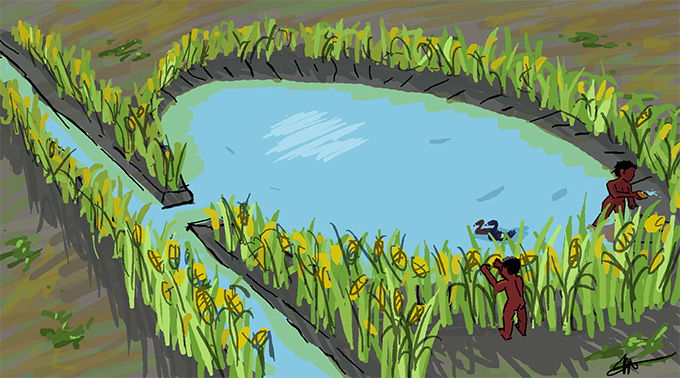
Water engineers in ancient South America turned seasonally flooded Amazonian savannas into hotbeds of year-round maize farming.
Casarabe people built an innovative, previously unrecognized network of drainage canals and water-storing ponds that enabled two maize harvests annually, say geoarchaeologist Umberto Lombardo of the Autonomous University of Barcelona and colleagues. Large-scale maize cultivation during rainy and dry parts of the year fed the rise of Casarabe urban sprawl across Amazonian forests and savannas in what’s now northern Bolivia, the scientists report January 29 in Nature.
Previous excavations dated Casarabe society, which covered an area of 4,500 square kilometers, to between the years 500 and 1400. Casarabe people had access to