
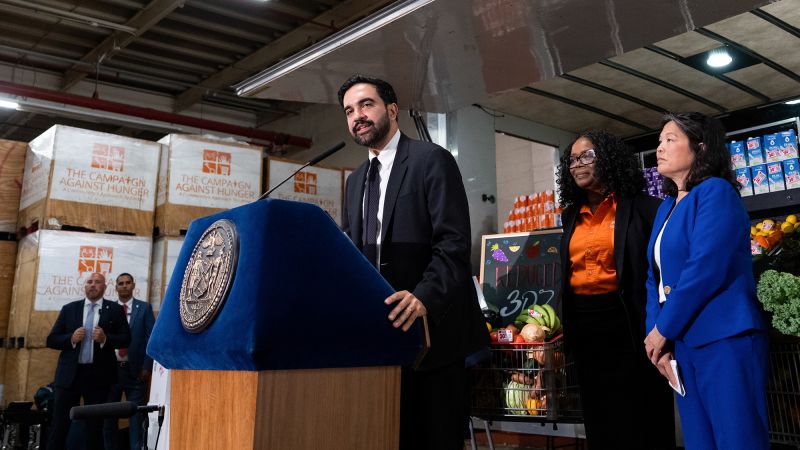
Whenever Mayor Zohran Mamdani offers new details about his plan to open five government-owned supermarkets in New York City, photos of Boris Yeltsin start circulating on social media.
New York
Whenever Mayor Zohran Mamdani offers new details about his plan to open five government-owned supermarkets in New York City, photos of Boris Yeltsin start circulating on social media.
Taken during Yeltsin’s trip to America months before the fall of the Soviet Union in 1989, the photos show the former Russian president astonished by the variety of frozen foods at Randall’s supermarket in Houston. Yeltsin tasted free cheese samples and surveyed the fish. He left the store with a goodie bag.
On the flight after the impromptu stop, Yeltsin sat motionless with his head in his hands, considering the bare shelves of Soviet food markets. “What have they done to our poor people?” he said, according to his biography.
Then, as now, America’s supermarkets are a marvel of the free market. The idea that government, which has been defined as incompetent and inefficient for decades, could provide grocery abundance and variety better than Walmart and Costco has triggered a visceral reaction among critics. They imagine “Mamdani marts” ending up like dreary state-run Soviet stores with one type of soup.
The response to Mamdani’s plan reflects something much deeper than the brand of ketchup public stores will sell or the price of eggs. It comes down to a fundamental disagreement about the responsibility of government.
Where supporters see government intervening to solve problems of everyday people struggling to afford groceries, others see a socialist mayor overreaching to take aim at a powerful symbol of America’s riches.
“The debate is not really about the specific mechanics of the model,” said Nevin Cohen, an associate professor at the CUNY School of Public Health. It’s a “test of competing ideas about what we expect government to provide.”
Never mind that the public stores aren’t a radical new idea and the city is bringing in private operators to manage them and source the food. Or that 99% of New Yorkers will never shop at one of them. They will not destroy John Castimatidis’ Gristedes supermarket empire.
The American supermarket, with its endless array of products and innovations like the shopping cart and barcodes, has achieved an almost mythical status around the world. Supermarkets helped America project democracy abroad and win the Cold War. For decades, the U.S. Information Agency distributed images of supermarkets to promote the benefits of the “American way of life.”
They are a bounty of consumer choice. Between 1960 and 2010, the number of different products in an average US supermarket grew from 6,000 to 47,000. New business models such as Walmart supercenters, Costco warehouse clubs and Trader Joe’s specialty stores expanded the abundance further.
“Food is a potent symbol and catalyst for people’s politics,” said Tracey Deutsch, a historian at the University of Minnesota who studies food and capitalism. Stores were contested sites during the civil rights movement and the pandemic, she noted.
“There’s a sense that grocery stores are the last bastion,” she said. “Grocery stores are places where people make their stand for the world they want.”
Supporters of private sector solutions to address food insecurity say New York City should make it easier for Walmart to open or pay for Costco memberships for people who can’t afford them.
But Mamdani’s animating political philosophy is to use government to solve everyday problems in people’s lives.
He is following in the footsteps of his political idol, Mayor Fiorello LaGuardia, a champion of government intervention during the New Deal who built public parks, housing and the airport that bears his name. Overcoming opposition from private industry, LaGuardia opened a network of city-run indoor markets during the 1930s to move pushcart vendors off streets and reduce the cost of groceries. Several of the markets are open today.
Mamdani wants to turn the vacant sites, still owned by the city, into public grocery stores.
LaGuardia “believed in a simple definition of the task of government to make people’s lives better,” Mamdani said last month. “We are one step closer to fulfilling that fundamental responsibility.”