Folding a flat piece of paper into a torus — a shape with a hole in the middle — demands origami skill. That’s something mathematician Richard Evan Schwartz lacks. Yet he answered a lingering mathematical question about the process.
His work — performed mainly on a computer rather than with paper — reveals the smallest number of folds needed to make a paper torus. The paper must have at least 24 folds, forming 16 triangles that meet at eight points, or vertices, Schwartz reports in the May 26 Proceedings of the National Academy of Sciences.
To make a torus from a piece of paper, you can roll it into a tube and bend the tube to connect its two ends, making a doughnut. That would probably involve some inelegant crinkling and potentially a few paper cuts.
A more refined method involves creasing the paper in a definite number of triangles, allowing it to elegantly fold into the desired shape. Schwartz, of Brown University in Providence, R.I., has an affinity for minimal mathematical objects; he previously found the shortest possible Möbius strip. So he wanted to know how to make a torus with the fewest folds, or equivalently, the smallest number of vertices.
To create a torus from a flat piece of paper, a mathematical requirement must be met at each of the torus’s vertices — the places where triangles meet. For each vertex on the torus, the angles of the triangles that meet there should add up to 360 degrees. Think of a pizza, cut into slices. Add up the angles at the tip of each slice and you’ll get 360 degrees.
A torus with nine vertices that met this condition had been discovered previously. Mathematicians had also described a torus with just seven vertices, but no one knew whether all seven could meet the pizza-slice requirement. Schwartz proved one of the vertices would always fail that test, ruling out a seven-vertex paper torus.
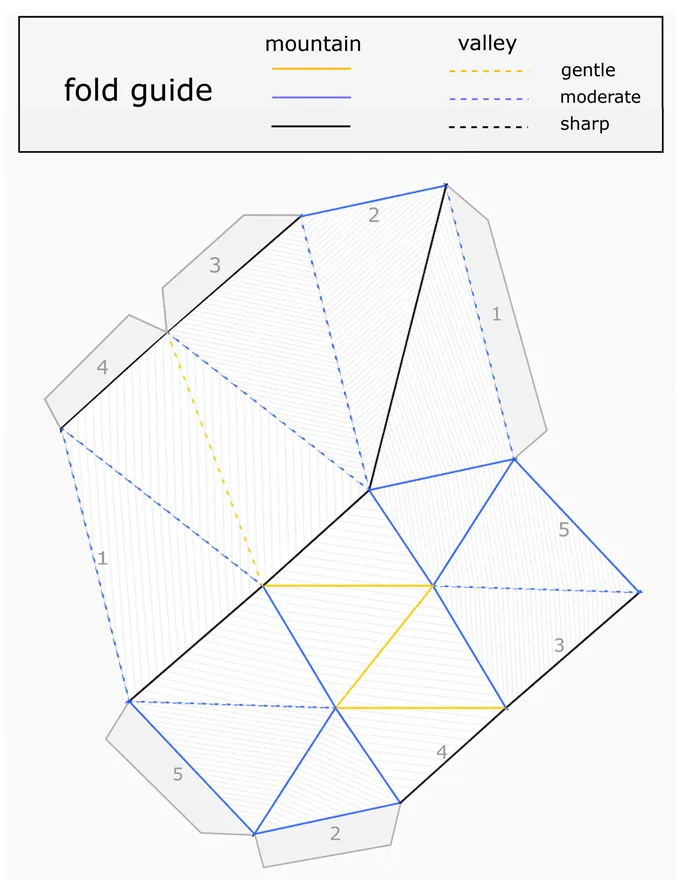
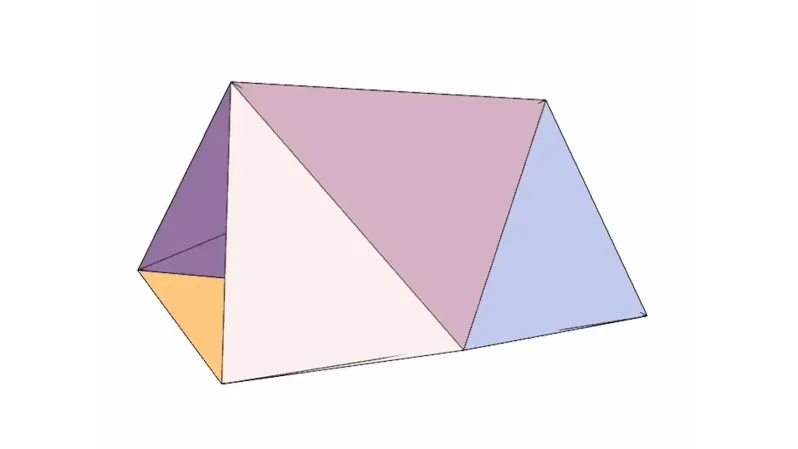
Then, Schwartz used machine learning to see if a torus with eight vertices was possible. His program identified a folding pattern that worked. When constructed, it looks like a pup tent with an extra flap inside. Schwartz created a pattern so anyone can fold their own — as long as their origami skills are up to the task.
Mathematician Richard Evan Schwartz discovered how to make an origami torus with the least folding possible. The tent-shaped object has a thin hole through its middle, and requires just 24 folds that form 16 triangles, meeting at eight vertices. Make your own minimal paper torus by printing out this pattern and folding as directed.