
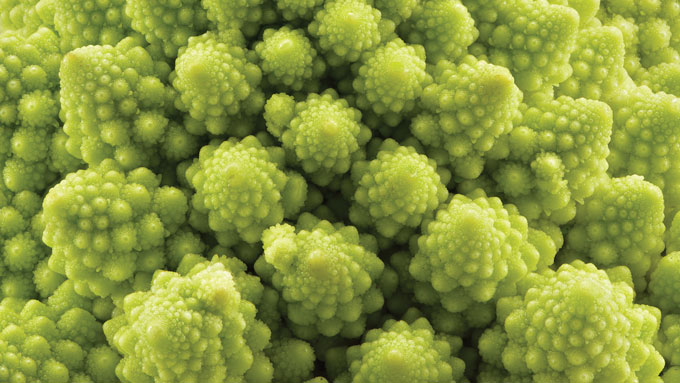
Fifty years ago, “fractal” was born.
In a 1975 book, the Polish-French-American mathematician Benoit B. Mandelbrot coined the term to describe a family of rough, fragmented shapes that fall outside the boundaries of conventional geometry. Mathematicians had been describing these types of shapes since the late 19th century. But by giving them a name — derived from fractus, Latin for “broken” — Mandelbrot gave fractals value. He introduced a way to measure and analyze them. With a name, he recognized order in complexity.
If you know anything about fractals, it’s probably this: Their hallmark trait is self-similarity. No matter how much you zoom in or out, you find similar patterns. Take a snowflake.